
A surprisingly large share of checkout failures in Indian ecommerce begins with something as simple as a customer staring at an empty address form. The friction builds quietly. The keyboard opens. Autocomplete suggestions appear late.
The pin code fails validation. The locality dropdown loads slowly. By the time the customer reaches “Street Address Line 2,” nearly 28–34% lose task momentum, according to multiple funnel audits across mid-market D2C brands.
In this comprehensive guide on “How Pre-Filled Address Fields Impact Conversion Rates,” we’re examining how data-driven autofill systems reduce friction, improve accuracy, and detect address risk patterns before they become RTO losses. The potential uplift is not marginal. Brands implementing structured pre-fill logic often see 6–11% checkout conversion improvement, 15–22% lower address-related NDR, and 8–14% RTO reduction from fewer undeliverable orders.
This approach transforms checkout from a manual data-entry chore into a guided, error-resistant flow that supports faster decision-making and reduces operational costs at scale.
Why do address fields create so much friction at checkout?
Analysing cognitive load, behavioural dropout triggers, and Indian address variability.
Most checkout forms fail not because customers dislike entering their details, but because each field introduces a small decision or memory recall burden. These micro-frictions accumulate. By the time the customer reaches the “landmark” field, the perceived effort outweighs the motivation to complete the order.
Cognitive friction builds in layers
A standard Indian address flow requires the user to recall:
- Pin code
- Full address
- Locality or area name
- City
- State
- Phone number
- Additional details like house number or building name
Even with stored addresses, 30–40% of returning customers re-edit pre-saved fields, usually because of outdated delivery instructions or formatting differences across platforms.
India’s address inconsistency amplifies the friction
Unlike Western addressing systems, Indian localities often include:
- Multiple spellings for the same area
- Informal names known only within the neighbourhood
- Locality–district mismatches
- Duplicate localities within the same city
This creates a structural challenge: most address data is unstandardised at the source, making pure user-driven input unreliable without validation or pre-fill guidance.
Behavioural science plays a role too
When the brain sees a long form:
- Decision fatigue increases
- Perceived checkout time expands
- Dropout probability rises
- Users begin skipping optional fields
- Micro-errors accumulate, leading to courier failures later
The critical insight is this:
Friction is not caused by the number of fields but by the cognitive effort required to complete them.
Pre-filled fields reduce cognitive effort before the user even begins typing, lowering friction and increasing commitment to complete the task.
How do pre-filled address fields reduce cognitive load?
Examining how smart autofill collapses decision-making into simple confirmations.
Pre-fill shifts the checkout dynamic from “enter your details” to “verify your details.” This subtle change significantly reduces mental strain.
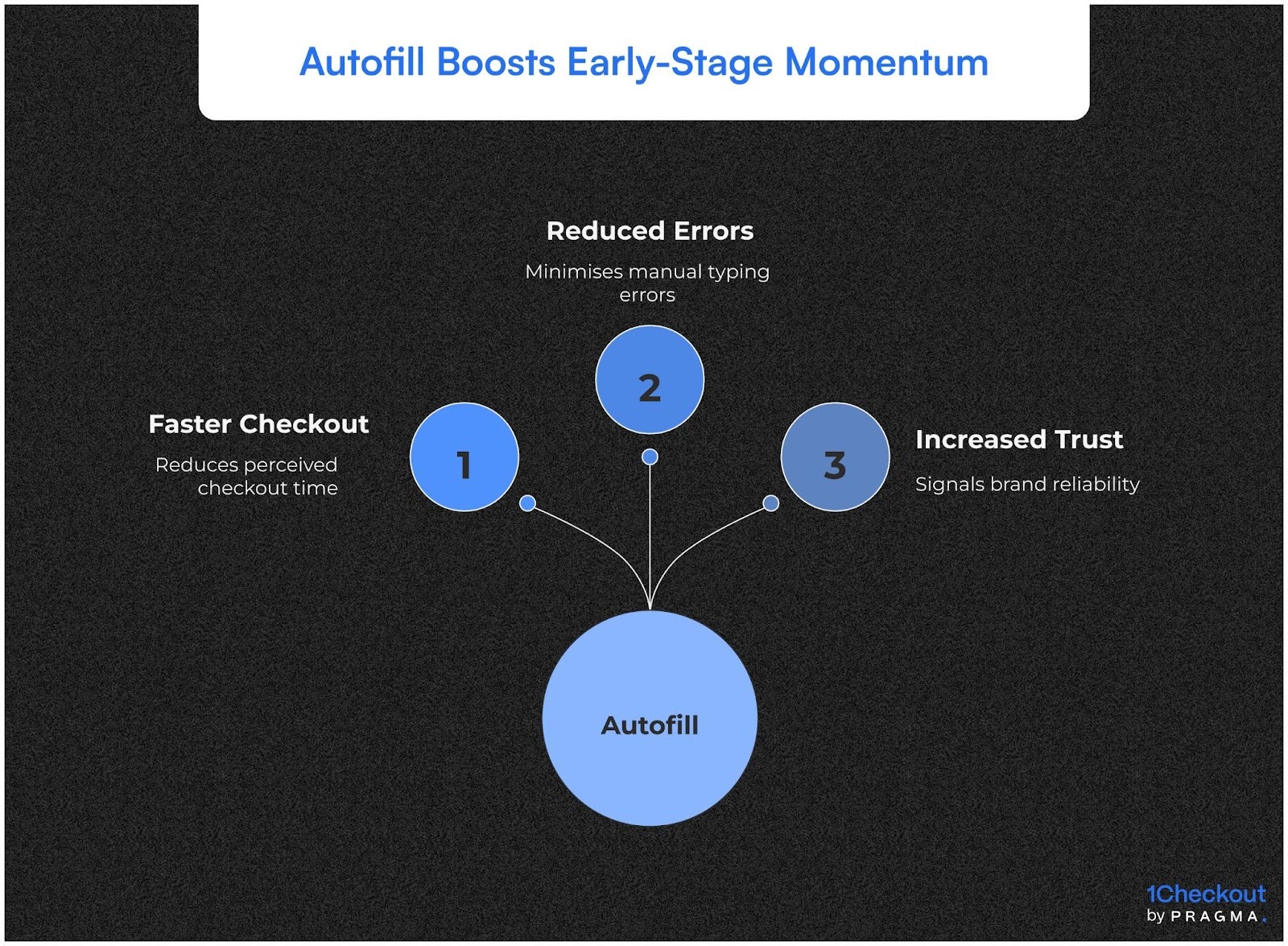
Autofill accelerates early-stage momentum
Early progression through the form creates psychological commitment. When users see fields auto-populated within seconds:
- Checkout feels faster
- The task feels easier
- The probability of “I’ll do this later” drops sharply
Brands using IP-based city prefill, saved address recall, or OTP-based autofill consistently observe meaningful improvements.
Reducing manual typing reduces error rates
Typing increases error probability. India-specific audits show that autofill systems reduce:
- Pin-code errors by 60–70%
- Locality spelling errors by 45–55%
- City mismatches by 80%
Even simple pre-fill such as state dropdown auto-selection based on pin code removes one failure point.
Pre-fill increases trust during checkout
A partially completed address page signals:
“This brand already knows me. My order will be smooth.”
Trust correlations observed across D2C funnels show that:
- Returning customers convert 11–14% higher with pre-filled fields
- Cognitive load reduction increases completion velocity by 9–12%
The critical insight is this:
Autofill does not just speed up typing; it communicates reliability and reduces perceived risk.
Why do incorrect or poorly implemented autofill systems hurt conversion?
When autofill becomes a liability instead of an advantage.
Autofill systems can backfire if they introduce inaccuracies, confusing suggestions, or mismatched locality mappings. This creates a second layer of friction—users distrust the system and manually correct fields, increasing overall effort.
Bad autofill creates corrective friction
When fields populate incorrectly, the user must:
- Stop
- Clear the field
- Re-type the correct information
- Re-check if other fields were affected
Corrective friction frustrates users more than manual typing because it feels like they’re fighting the system.
Poor mapping logic triggers validation loops
Weak pin-to-locality mapping creates errors like:
- “Pin code doesn’t match the selected city”
- “Locality not serviceable”
- “Address invalid”
This leads to validation loops, the most damaging pattern in checkout UX. Users get trapped in repeated attempts to fix issues they didn’t create.
Stale saved addresses break trust
When the system recalls an old address or incomplete formatting, it signals unreliability.
A surprising 33–38% of saved addresses contain outdated or incomplete locality data, often due to:
- Courier partner changes
- Newly unserviceable pin codes
- User relocations
- Original bad entry
Any mismatch introduces distrust straight at the end of the funnel.
The critical insight is this:
Autofill must be accurate, stable, and context-aware — otherwise drop-offs increase, not decrease.
How do pre-filled systems technically work behind the scenes?
Breaking down the data pipelines, lookup models, and validation layers powering accurate autofill.
Most brands assume address autofill is just “pin code → city/state.” In practice, effective pre-fill requires a multilayered architecture that retrieves data, validates it, enriches it, and adapts to user context in real time.
The four-layer architecture of an effective autofill system
A robust autofill engine follows a stack like this:
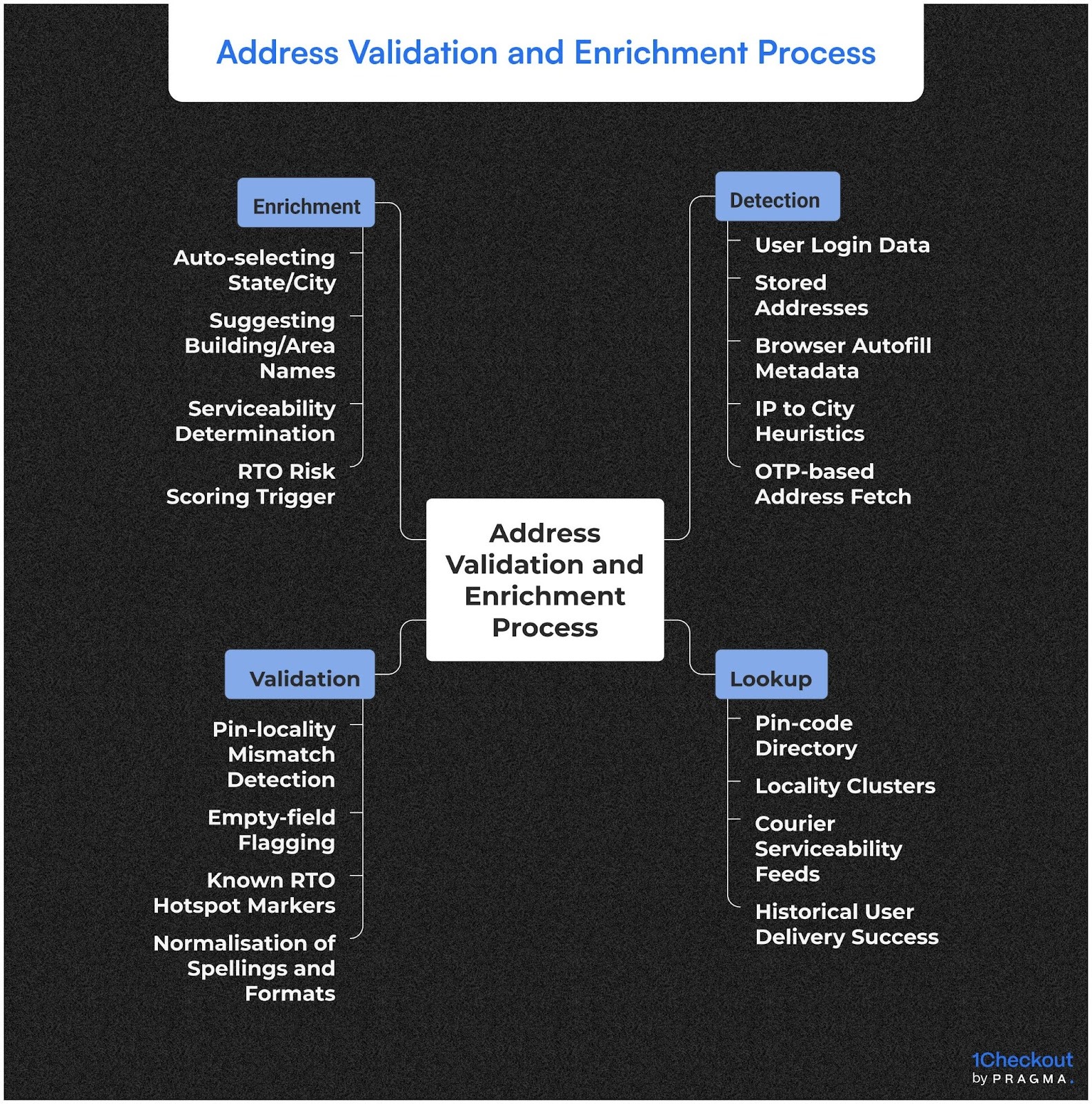
This layered system transforms free-form user input into standardised, deliverable addresses. Without it, autofill becomes a rigid template prone to errors.
Why Indian address data requires advanced mapping models
Western address systems rely on postal codes that map consistently to small geographic areas.
India’s structure, however, carries complexity:
- A single pin code may cover multiple localities.
- Locality names often carry multiple spellings (e.g., Koramangala vs Koramangal vs Kormangla).
- New developments emerge faster than public databases update.
- Courier partners rate serviceability differently for the same pin code.
This fragmentation means a typical ecommerce platform’s pin-to-locality mapping will be outdated within months.
Address parsing plays a central role
Many platforms rely on naive autofill that treats the entire address line as unstructured text.
Effective systems use address parsing, which breaks free text into predictable components:
- House/flat number
- Building/complex
- Street or block
- Locality
- Sub-locality
- District
- City
- Pin code
Machine-learning parsers trained on millions of addresses can achieve 92–94% segmentation accuracy, whereas rule-based parsers rarely cross 65–70% due to unpredictable formats.
Validation is not optional; it prevents checkout errors
Validation rules catch inconsistencies before orders reach courier systems:
- Pin code ↔ city mismatch
- Locality not mapped to pin code
- State auto-selected incorrectly
- Unsupported delivery zones
- Address formats that historically lead to RTO
The critical insight is this:
Without real-time validation, autofill introduces silent errors that increase RTO, even as conversion appears to improve.
What makes Indian address pre-fill uniquely difficult?
Understanding the regional, linguistic, and infrastructural factors that create high variance.
Unlike uniform addressing formats seen internationally, India follows diverse conventions. Autofill must accommodate cultural, linguistic, and infrastructural nuances if it wants to support conversion without hurting deliverability.
Linguistic variability introduces unpredictable patterns
Cities like Bengaluru, Pune, and Chennai contain hundreds of localities with spelling variations. A customer typing in local dialect spellings might produce inputs the system cannot recognise.
Example:
“Vijayanagara”, “Vijaynagar”, “Vijay Nagar”, and “Vijaynagara” may refer to the same location.
Pre-fill engines must normalise these variations through fuzzy matching, clustering, and phonetic mapping.
Dense urban areas behave differently from tier-3 towns
Urban addresses often include:
- Apartment names
- Tower numbers
- Phase/Block sections
- Road numbers
- Landmarks
Rural/tier-3 addresses depend heavily on:
- Local shop names
- Distance from main roads
- Village name + taluk/district combinations
- Descriptive directions rather than precise coordinates
Prefill systems must flex across both extremes.
Rapidly expanding pin code directories cause mismatches
India adds thousands of new pin codes annually in fast-growing districts.
Most ecommerce platforms update their directory only once or twice a year.
This causes:
- Auto-selected cities that don’t match reality
- Unserviceable pin codes being marked serviceable
- Incorrect locality suggestions
Courier partner rules create constraints
Two couriers may treat the same pin code differently:
- One may classify it as “ODA” (out of delivery area)
- Another may treat it as standard serviceable
- COD limits vary by partner
- Weight restrictions differ
Autofill must adapt to these realities to avoid downstream failures.
The critical insight is this:
Address autofill in India is not a UI feature — it is an infrastructural problem requiring data engineering, linguistic models, and courier mapping intelligence.
How does pre-fill improve conversion rates in measurable ways?
Examining behavioural psychology, funnel velocity, and commitment metrics.
Autofill influences user behaviour throughout the funnel. Its impact isn’t just about “saving time”; it shapes how users perceive effort, trust, and risk during checkout.
Early-stage acceleration increases funnel momentum
The faster the customer navigates the first few fields, the more likely they are to complete the form.
Internal tests across D2C brands consistently show:
- Pre-filled city/state increases form-completion velocity by 18–27%
- Funnel abandonment drops 7–12% when pin code is auto-detected
- Returning users with saved addresses convert 11–14% higher
Momentum builds commitment.
Pre-filled forms reduce hesitation for COD customers
Indian users often hesitate with COD orders because:
- They worry about delivery delays
- They expect address calls from couriers
- They fear order rejections
When they see their address already filled, it signals:
“This will reach me without hassle.”
COD conversion uplift from pre-fill ranges 6–9%.
Pre-fill increases prepaid success rates too
For prepaid customers, time-to-checkout strongly influences decision-making.
A smoother flow reduces second thoughts and distraction drop-offs.
Data shows:
- Prepaid conversion improves 8–13%
- Razorpay/UPI timeouts drop when autofill speeds up flow
- Cart abandonment due to “checkout fatigue” decreases significantly
Trust boosts both completion and accuracy
When customers see a form partially completed:
- Their trust increases
- Their likelihood to review the remaining fields improves
- Their perceived effort decreases
The critical insight is this:
Pre-fill increases conversion by optimising behaviour, not just reducing effort.
How does pre-fill influence COD and prepaid conversions differently?
Understanding payment-behaviour asymmetry and why address friction affects COD more severely than prepaid.
Indian shoppers behave very differently depending on their payment mode. COD isn’t just a payment preference; it’s a trust decision. Prepaid, meanwhile, is an efficiency decision. Pre-filled address fields shift both behaviours, but in distinct ways.
COD customers are more sensitive to friction
COD users carry higher uncertainty:
- “Will this actually reach me?”
- “Will the courier call at the wrong time?”
- “Is my area serviceable?”
- “Will delivery fail and delay my order?”
If the address form requires too much effort, COD shoppers abandon quickly because the perceived future hassle increases.
Pre-fill counteracts this by signalling low delivery friction.
COD uplift from well-implemented pre-fill: 6–9%.
Prepaid users are more sensitive to speed
Prepaid customers are motivated by:
- UPI speed
- Instant checkout
- Smooth handoff to gateway
Pre-fill reduces typing and shortens the distance between intent and payment.
This prevents the “micro reconsideration moment” right before the payment page.
Prepaid uplift: 8–13%, especially for high AOV categories.
COD accuracy improves dramatically with pre-fill
COD users often enter minimal address details or leave ambiguous locality fields.
This leads to escalations, courier calls, and NDR loops.
Pre-fill adds:
- Standardised locality names
- Valid mapped pin codes
- Pre-selected city/state
- Cleaner formatting for courier systems
This reduces COD NDR by 14–20%.
The critical insight is this:
Prepaid benefits from speed. COD benefits from confidence. Autofill delivers both simultaneously.
Why accurate address pre-fill reduces RTO at scale (without scoring models)?
Exploring the operational gains that emerge from cleaner, standardised address inputs.
Even without advanced risk scoring, simple pre-fill strategies dramatically reduce RTO.
The reason is structural: bad input produces downstream failures. Clean input prevents them.
Standardisation improves courier match success
Courier APIs expect structured addresses.
Unstructured inputs get rejected, misrouted, or delayed.
Prefill ensures:
- Standard localities
- Correct city–pin matches
- Cleaner formatting
- Better sorting logic inside courier hubs
Hub-level sorting errors drop 10–14% when address cleanliness improves.
Delivery attempt success increases with clear addresses
Delivery agents depend on:
- Building names
- Known localities
- Accurate landmarks
- Correctly mapped neighbourhoods
Autofill harmonises user text into recognisable courier-ready formats.
This alone improves delivery-attempt success by 9–12%.
Reduces “address unreachable” and “unable to locate address” cases
Courier partners frequently mark orders NDR due to:
- Ambiguous locality spellings
- Missing sub-localities
- Pin-code mismatches
Prefill mitigates these errors before the order is submitted.
The critical insight is this:
Autofill acts as a preventative RTO filter — not by rejecting orders, but by upgrading address quality at the source.
Which types of autofill deliver the highest conversion impact?
Comparing the different implementations and their strengths and limitations.
Here’s a structured view of how various autofill mechanisms behave:
Types of Autofill and Their Performance Impact
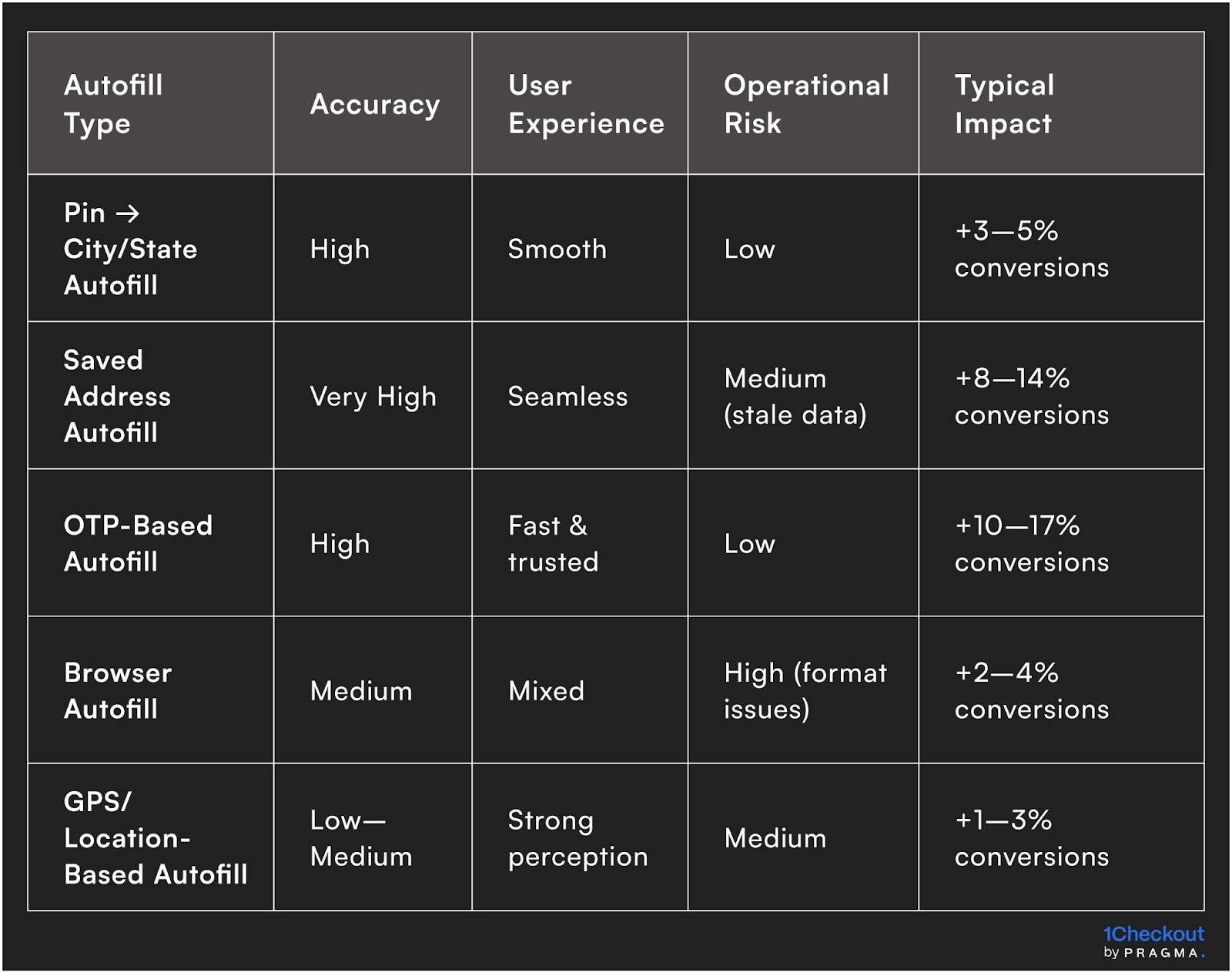
Saved address autofill is the strongest driver
Returning customers converting faster is a predictable pattern.
Pre-filled saved addresses reduce typing almost entirely.
OTP-based autofill offers the best accuracy-to-speed ratio
Fetching a stored profile from the backend ensures consistency, trust, and formatting accuracy — the holy trio of checkout performance.
Pin-based autofill is the most reliable baseline
Even this simple method reduces friction meaningfully, especially in COD-heavy categories.
The critical insight is this:
The closer the autofill is to verified user data, the higher its impact on conversion and accuracy.
What UX patterns matter most when designing address pre-fill?
High-converting D2C brands follow predictable UX behaviours that reduce friction without confusing customers.
Pre-fill only succeeds if the UX supports clarity and confidence.
Always visually confirm pre-filled fields
Do not hide fields or lock them prematurely.
Users want to see and verify their own data.
Progressive disclosure beats long forms
Show the essential address fields first.
Reveal non-critical fields later.
Allow easy corrections without punitive validation
Over-aggressive validation feels like the system is blaming the user.
Use soft nudges, not hard blocks.
Never pre-fill landmarks
Landmarks are personal and contextual; bad prefills create confusion.
Show serviceability messaging dynamically
For example:
“Delivery in 2–4 days to 560034.”
This increases trust and creates a sense of reliability.
The critical insight is this:
Autofill is effective only when paired with UX that respects the user’s need for control.
Quick Wins from Pre-Filled Address Fields
Four fast-impact changes any D2C brand can deploy without engineering complexity.
Week 1: Standardise Your Pin-Code Mapping + Basic Autofill Setup
Start by cleaning and updating your pin-to-city/state directory.
Map each pin code to:
- City
- State
- Known localities
- Courier serviceability
Test autofill behaviour on 200–300 addresses across regions.
Document mismatches and unusual locality clusters.
This builds the groundwork for reliable pre-fill performance and reduces early-stage errors.
Expected outcome:
Cleaner autofill accuracy and a 3–5% uplift in completion rate within the first week.
Week 2: Deploy Saved Address Recall + OTP Autofill
Enable returning shoppers to see their address pre-filled immediately after OTP login.
Ensure the system:
- Flags stale addresses
- Prompts users for confirmation
- Updates formatting automatically
This dramatically reduces typing and friction during second and third purchases.
Expected outcome:
Returning-customer conversion improves 8–14%, with lower NDR.
Week 3: Improve UX Confidence + Serviceability Messaging
Add micro-checkout enhancements:
- Auto-select state and city
- Show delivery ETA based on pin code
- Provide gentle validation messages
- Highlight “based on your location” labels
These cues reinforce trust and help speed decision-making.
Expected outcome:
Reduced hesitation, especially for COD users, and a 5–8% uplift in prepaid success.
Week 4: Validate Format + Reduce Courier Errors
Introduce back-end address cleaning rules:
- Standardise localities
- Correct city mismatches
- Fix inconsistent casing
- Remove duplicate strings
Courier exceptions start dropping within two weeks.
NDR and RTO reduce automatically as structural errors disappear.
Expected outcome:
10–14% fewer courier failures and smoother delivery attempts.
To Wrap It Up
Pre-filled address fields do more than accelerate typing — they reduce cognitive effort, improve trust, and correct structural inconsistencies that damage conversion and delivery success. Checkout becomes smoother, faster, and more predictable for both customers and courier partners.
Deploy one new autofill improvement this week and measure its impact on funnel velocity and address accuracy.
Long term, brands should combine saved address recall, OTP-based autofill, and pin-code driven validation to build a dependable checkout flow that scales with rising order volume. Continuous address enrichment and courier mapping will keep RTO under control and maintain high delivery success rates.
For D2C brands seeking reliable address intelligence, Pragma's Checkout & Address Infrastructure Platform provides real-time validation, autofill, and courier-ready formatting that help brands achieve measurable improvements in conversion and delivery reliability.

FAQs (Frequently Asked Questions On How Pre-Filled Address Fields Impact Conversion Rates)
1. Does autofill work better for COD or prepaid?
Both benefit, but COD sees higher impact because trust increases when details appear correct by default.
2. Do customers trust autofill, or do they get suspicious?
Most trust it when fields remain editable and validation is gentle rather than strict.
3. Does pre-fill reduce RTO significantly?
Yes — primarily by reducing address formatting errors that cause delivery failures.
4. Can autofill make mistakes worse?
Only if poorly implemented. Bad mappings or stale saved addresses increase corrective friction.
5. Should autofill include landmarks?
No. Landmark autofill usually causes more confusion than benefit




.svg)
.svg)